
Chainlink Runtime Environment: Why On-chain Logic Needs a Real Execution Layer
Smart contracts are extremely good at doing exactly what they are told. They execute deterministically, settle value reliably, and remove the need to trust intermediaries. That precision is what made them foundational to decentralised applications.
On the other hand, their main limitation is that most real world systems need more than deterministic execution. Smart contracts need to react to external events, coordinate across networks, and handle workflows that unfold over time rather than inside a single transaction. As decentralised applications matured, developers filled this gap by stitching together off-chain services, bots, and scripts around their smart contracts.
Chainlink Runtime Environment (CRE) exists because this approach does not scale cleanly, as it introduces a structured execution layer that allows decentralised applications to behave more like complete systems rather than isolated contracts.
Understanding Chainlink Runtime Environment
Chainlink Runtime Environment is a runtime for decentralised services. In plain terms, it provides an environment where application logic can run securely outside the blockchain while remaining tightly connected to on-chain contracts.
CRE allows developers to build long running and composable services that combine on-chain logic with off-chain execution. Instead of forcing all logic into smart contracts, applications can define workflows that react to events, fetch and verify external data, perform computation, and then return results on-chain in a coordinated way.
Under the hood, CRE is built on upgraded decentralised oracle networks, often referred to as DONs. These networks no longer only deliver data feeds, as they also act as execution clusters capable of running off-chain logic in a decentralised and fault tolerant manner. The result is a runtime that supports complex application behaviour without relying on trusted servers or bespoke infrastructure. We should emphasise the fact that CRE does not replace smart contracts, but it extends them by handling the execution patterns that smart contracts were never designed to manage on their own.
Why CRE Exists
CRE is the result of Chainlink’s natural evolution beyond simple price feeds. While oracles initially focused on bringing external data on-chain, modern decentralised applications increasingly require secure off-chain execution as well. As applications grew more complex, teams began running critical logic off-chain using scripts, bots, and centralised services. This created security risks, operational fragility, and coordination challenges, especially when applications needed to interact across multiple chains and external systems.
At the same time, demand increased for workflows that could span blockchains, traditional systems, and real world processes. Coordinating these systems securely using only smart contracts proved impractical, especially at production scale.
CRE exists as the logical next step as it formalises off-chain execution into a decentralised runtime that preserves trust minimisation while enabling coordination across chains and systems. Rather than working around smart contract limitations, CRE addresses them directly at the infrastructure level.
Core Components of Chainlink Runtime Environment
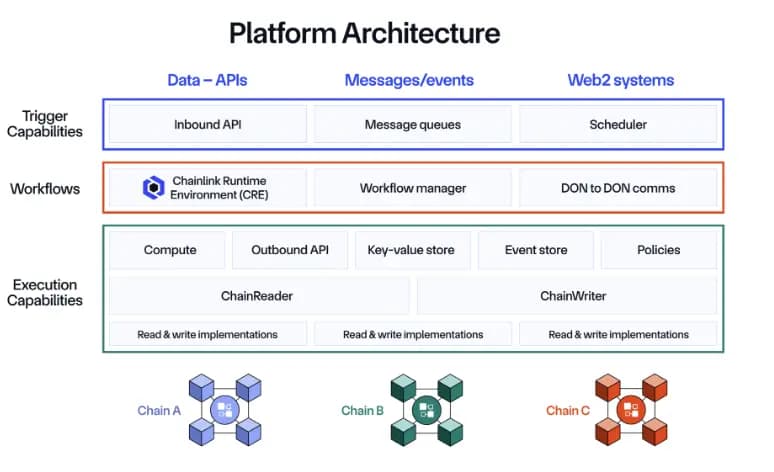
Chainlink Runtime Environment is composed of several core components that work together to enable decentralised execution. At the foundation are decentralised services, operated by independent node operators, that execute logic collectively rather than relying on a single trusted party. This ensures resilience and fault tolerance even when execution happens off-chain. These services are organised into decentralised oracle networks that now function as execution clusters. Instead of only delivering data, DONs can coordinate the execution of workflows, manage state transitions, and interact with on-chain contracts in a structured and verifiable way.
CRE also enables secure off-chain computation. Logic that would be too expensive, too slow, or impractical to execute on-chain can be performed off-chain and then settled on-chain once execution is complete. In practice, this shifts complexity away from smart contracts while maintaining strong execution guarantees.
This is precisely where dependable infrastructure becomes essential. Off-chain execution still relies on reliable node operation, consistent performance, and high availability. For infrastructure providers like Spectrum Nodes, this is the layer where execution reliability, observability, and uptime directly affect application behaviour.
Native multi-chain support is another core element. CRE is designed to work across multiple blockchains, aligning with Chainlink’s broader cross-chain strategy and interoperability tooling. In turn, this allows workflows to coordinate actions across different networks without introducing trusted intermediaries.
Together, all these components form a general purpose execution layer that sits alongside smart contracts rather than replacing them. For technical details on how these components interact, we encourage you to visit Chainlink’s documentation provides a deeper reference.
Real World Use Cases Enabled by CRE
The value of CRE becomes clearer when looking at real world outcomes rather than abstract architecture. For example, in real world asset and compliance workflows, CRE can coordinate data verification, regulatory checks, and settlement logic across multiple systems before committing results on-chain. This allows sensitive logic and validation steps to happen off-chain while maintaining clear auditability and deterministic outcomes on-chain.
Decentralised finance protocols can use CRE to manage complex execution logic such as automated risk management, dynamic parameter updates, or multi-step strategies that would be impractical or inefficient to run entirely on-chain. By shifting this logic into a decentralised execution layer, protocols gain flexibility without introducing central points of failure.
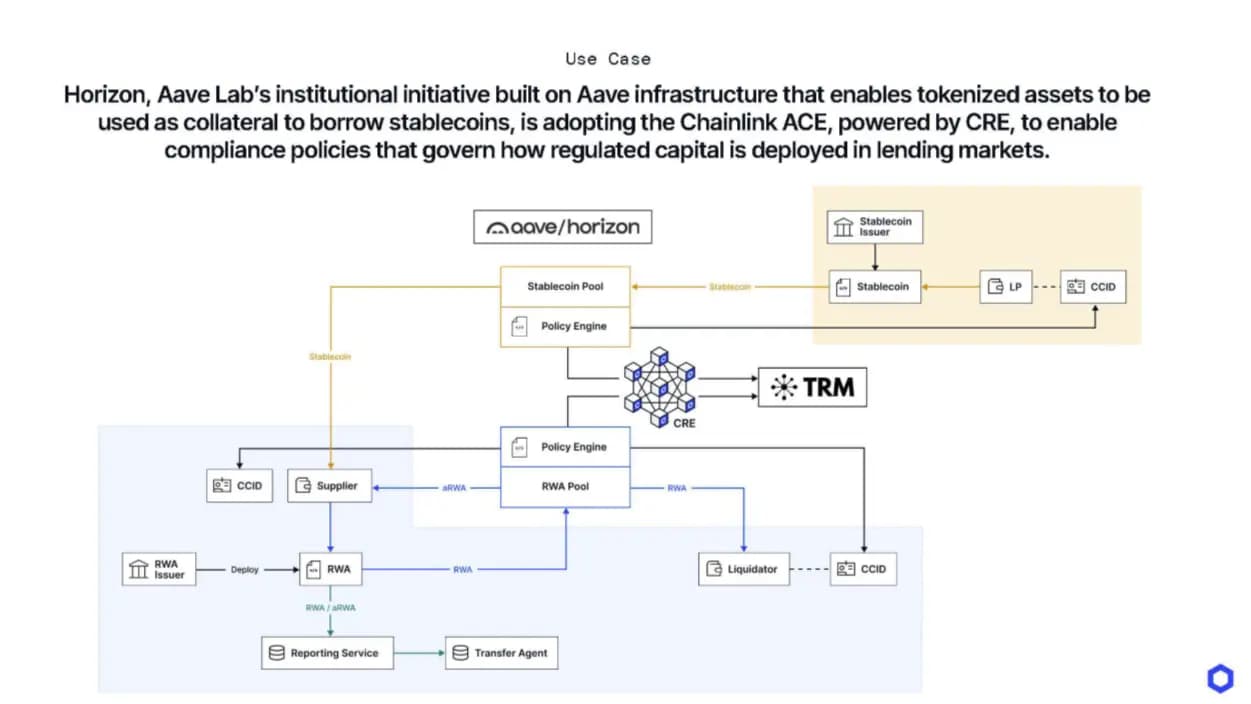
Cross-chain asset management also becomes more viable when execution logic can coordinate actions across multiple networks in a structured way. Rather than relying on centralised relayers or brittle scripts, CRE enables workflows that are executed collectively and verified across decentralised oracle networks.
Institutional automation is another area where CRE plays an important role. Financial institutions often operate across a mix of on-chain contracts, internal systems, and regulatory processes. CRE allows these workflows to be orchestrated coherently, enabling coordination between blockchain based logic and traditional operational controls.
Additionally, CRE also opens the door for AI agents that can observe conditions, make decisions off-chain, and act on-chain under clearly defined rules. Instead of autonomous systems pushing transactions directly, CRE enables those actions to be mediated through decentralised execution, making outcomes verifiable and resistant to single point failures.
It is worth pointing out at this stage that across all of these use cases, reliable execution depends not just on architecture, but also on infrastructure. Off-chain workflows still require dependable node operation, predictable performance, and continuous availability. This becomes especially clear when execution logic depends on external calls, time sensitive actions, or coordinated workflows.
This is the layer where infrastructure providers such as Spectrum Nodes focus their work, ensuring that decentralised execution remains reliable under real world conditions. For a deeper look at how infrastructure reliability affects decentralised applications in practice, we highly encourage you to read Spectrum’s article on what happens when RPC infrastructure fails.
Why CRE Matters for the Crypto Stack
CRE represents a meaningful shift in Chainlink’s role within the crypto stack. Rather than acting primarily as a data provider, Chainlink is increasingly functioning as a decentralised coordination and execution layer that connects smart contracts with off-chain systems. This shift enables more advanced applications without reintroducing trusted intermediaries, which in practice means that developers can design systems that behave more like modern distributed applications while preserving the security guarantees and trust minimisation that decentralisation demands.
From an infrastructure perspective, this also raises the bar. Execution layers only deliver value when they are reliable in practice, not just in theory. As decentralised applications move critical logic off-chain, the quality of execution environments and node infrastructure becomes a first order concern rather than an implementation detail.
In that sense, CRE is not an incremental upgrade. It expands what decentralised applications can realistically achieve by aligning execution, coordination, and infrastructure into a coherent model.
Conclusion
Chainlink Runtime Environment is foundational rather than incremental. It reflects where decentralised infrastructure is heading as applications demand more coordination, execution, and flexibility than smart contracts alone can provide.
CRE signals a future where crypto applications are not constrained by the limits of on-chain execution, but are supported by decentralised execution layers designed to handle real world complexity at production scale.
As more application logic moves off-chain, execution reliability becomes a first order concern. For builders and infrastructure teams, understanding how off-chain execution behaves under real world conditions is no longer optional. If this topic is relevant to what you are building, exploring how RPC reliability affects decentralised applications is a useful next step.
To keep exploring how decentralised execution works in practice, follow Spectrum’s blog for deep dives into node infrastructure, reliability, and real world blockchain performance.